Friday, September 24, 2021

Module 4: Mutation Rates

Mutation Rates: To answer the question of, "do you think mutation rates evolve?", I think that yes, they do evolve! Darwin talks of how individuals in a population have variation, and that how selection helps to pick and choose what traits are best fit to the environment that the organism lives in. So, it would make sense that mutation rates would also evolve. Depending on the organism and what their environment is like, having a fast, or even slow mutation rate high could be more beneficial than the other. So, natural selection would pick the rate that would be the most beneficial, and then in turn evolve the rate. It might become faster or slower overtime. 

Now, what makes a fast mutation beneficial and what makes a slow mutation rate beneficial? A fast mutation rate might be better fit because and organism might not be very fit in their environment, so a faster mutation rate would speed up the chance of a beneficial mutation happening in the population. A slow mutation rate might be good to have when an organism is already fit in their environment. Why change something when it isn't broken? Another reason a slow mutation rate is a good thing to have is that there is less of a chance for mistakes. When you are doing something super quick, there is a good chance that there will be some errors. Less errors means that the organism will probably reproduce and pass on their genes better than an organism that has a bunch of mistakes, (at least for the most part).

Personally, if I had to choose between having a slow mutation rate and a fast mutation rate, I think I would choose slow. In an article I read, Michael Lynch, a evolutionary biologist at the University at Arizona State University said that, "bacteria, paramecia, yeasts, and nematodes—all of which have much larger populations than humans—have mutation rates orders of magnitude lower [than humans]" (Pennisi). These organisms have lived for millions of years and they are still kicking it with a slow mutation rate. It seems like the right route to go to me!

Source: 
Pennisi, Elizabeth. “Why Microbes Are Better than People at Keeping Dna Mutations at Bay.” Science, American Association for the Advancement of Science, https://www.science.org/news/2018/04/why-microbes-are-better-people-keeping-dna-mutations-bay. 

Monday, September 13, 2021

Module 3: Fitness

In my opinion, the definition of fitness can vary greatly, as it depends on what you are talking about, (so I view it as being relative). In humans, being fit means that you are muscular and your body is in good shape. However, this is not true for all organisms. In terms of evolution, I believe being fit means that a population works well with its environment. It doesn't have to be the strongest or the fastest, but instead be what will keep them alive and be able to reproduce and pass on their genes to their offspring. Looking at the reproduction rate of a population is a good way to measure fitness. If a population is able to produce offspring, when there are others who can’t, there is a good chance that they have a high level of fitness.

An example of fitness can be found within the Mexican Blind Fish, (Astyanax mexicanus). These fish have evolved to have no eyes over the years. The caves that they live in do not have a lot of food, so they have to really conserve their energy between meals. Using one's eyes takes up a lot of energy, so by evolving to have no eyes, these fish became better fitted to their environment. These fish really didn't even need their eyes anyways, as they could not  see in a dark cave, (Owen).


(Above is a picture of a Mexican Blind Cave Fish. Credit: (ARTUR GOLBERT, ALAMY))

As one can see, natural selection definitely favored the individuals with reduced visual capacity, as it is a way to conserve energy when it is limited. 

The steps I would take to quantify fitness in Astyanax mexicanus are down below. I had a hard time coming up with anything more than this. It will be interesting to see if others have more or less steps!

Steps to see if an organism is “fit”:

1. See if the gene is actually beneficial towards the organism

Is it thriving with this gene?

Are others without this gene failing?

2. Check to see the gene can pass on to offspring

3. Observe offspring to see if trait is still useful 

I would also like to add that just because an organism is “fit”, doesn’t mean it will be deemed “fit” for life. An organism’s environment has the possibility to change quickly. For example, if the cave the Mexican Blind Fish were inhabitating suddenly had access to the sun, having no eyes would be a disadvantage instead of an advantage, as they could be easily seen by any predators they might have.

Resources:

Owen, James. “How This Cave-Dwelling Fish Lost Its Eyes to Evolution.” Animals, National Geographic, 3 May 2021, ....www.nationalgeographic.com/animals/article/150911-blind-cavefish-animals-science-vision-evolution. 

Tuesday, September 7, 2021

Module 1: Evolution: Fact or Theory?

Is evolution a fact or theory? In order to answer this question, I will define what evolution is. In my opinion, evolution occurs when an inheritable trait passes across generations. Evolution also cannot happen to an individual. For example, we as humans can't just randomly decide we want to grow a larger head. The large head trait would have to be favorable to have, and then throughout the generations, humans heads would then grow. Factors such as genetic drift, natural selection, and genetic mutation all can play a part in evolution, but just because these things happen, doesn't necessarily mean that evolution has occurred. Now that I have defined evolution, I think in order to answer this question, defining theory would also be beneficial. A theory is an explanation for something, usually backed from studies or evidence. An example of a theory would be the theory of gravity. I often get a "theory" and a "hypothesis" mixed up, so I have included a picture below to help distinguish between the two!


As you can see, the main difference between the two is that a theory is supported by evidence, while a hypothesis is not. I think it is safe to say that evolution started off as a hypothesis and then became a theory as more and more information was collected. I hope this helps!

Picture: (https://guides.library.unt.edu/PSCI3300/researchdesign)


After looking at these definitions, I would say that I believe evolution is a theory. We can't say it is a fact yet. I think this because it would be too hard to do so, as we know evolution has happened, but we don't know if all of the information we have on evolution is absolutely true. However, there have been studies done that have provided evidence to support evolution, so I think it would be right to say that it's a theory. To be a fact, we would have to be sure 100% about everything, (which we aren't). The study of evolution is ever changing as we are always learning new things about it!

Monday, September 6, 2021

Module 2: Darwin's idea of descent with modification: Speciation!

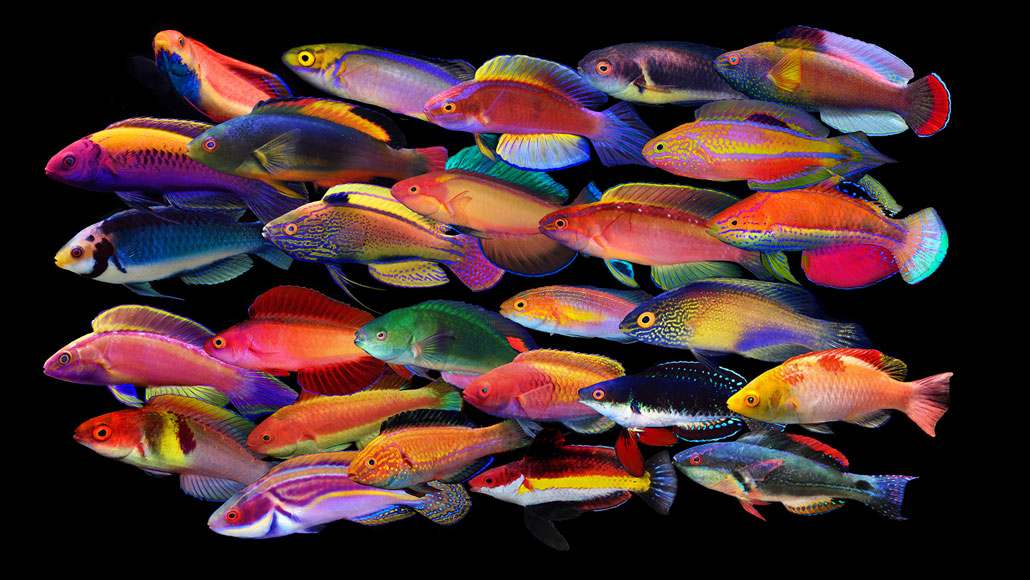
For this week's blog post, I decided to choose Darwin's "lineages split and diverge (speciation)" prediction based off of his ideas on descent with modification To really understand what this prediction meant, I looked up the word "speciation". According to Biology Dictionary, speciation is a process that occurs through evolution that in turn leads to a new, distinct species forming that are unable to reproduce with each other (Biology Dictionary). After scouring the internet, I was able to come up with an article that is a great example of this predication to prove that it is in fact a real thing. Jake Buehler's article discusses fairy wrasses (Cirrhilabrus), which are a type of fish. I have included a picture so you can see what they look like. 

male fairy wrasse fish

(Buehler)

Don't they look super cool? This is a picture of a group of males. They are vibrantly colored to attract mates (Buehler). The article goes on to say how it has taken 12 million years of evolution to produce the great array of colors that you can see above. As of now, there are 60 species of fairy wrasses, and new ones are still being discovered. Because of the large amount of different species of this one fish, scientists wondered how this could be. After comparing DNA from several different fairy wrass species, scientists discovered how they were interrelated and where they split from one another on the evolutionary tree (Buehler).

Fairy wrasses specifically diverged away from other wrass species about 12 million years ago, but many of the fairy wrass species we see today only emerged about 1 to 3 million years go in a coral reef in the western Pacific Ocean. Now they are found all over the place! Tea, a scientist, and his team think that this example of rapid evolution happened based off of where the fish were originally located. During the Pliocene and Pleistocene Epochs, ice ages changed the seascape where the wrasses lived. The ice turned the reefs into land bridges, which isolated fish on either side of the ice barrier. This encouraged speciation (Buehler).

Another way the fairy wrasses underwent speciation was picky males, (lol). Males had a lot of pressure to attract a mate and make sure she was of the right species. These fish eventually gained fluorescence in their scales, which only attracted certain females. This only furthered reproductive isolation (Buehler).


Sources:

Biology Dictionary, et al. “Microevolution: Definition, Examples, Quiz.” Biology Dictionary, 5 Oct. 2019, www.biologydictionary.net/microevolution/. 

Buehler, Jake. “Flamboyant Fishes Evolved an Explosion of Color as Seas Rose and Fell.” Science        News, 31 Mar. 2021, www.sciencenews.org/article/fish-fairy-wrasse-color-evolution-coral-reef-sea-   level-ice-age. 

Sunday, August 29, 2021

Introduction

Hello Everyone!

My name is Emmary Catlin. I am a junior here at Kansas State University majoring in Human Health Biology and minoring in History. I am from town in Kansas called Ottawa, which has just a little over 12, 000 people! After living in a rural area my whole life, I knew I wanted to have a career that I could do in a bigger city. Nothing is wrong with wanting to live in a small town, but I would just like a change in scenery. I get bored easily when I stay in the same place for too long :) I plan on going to graduate school to continue my education, (hopefully out of state). I am still deciding on what I want to do, as I am passionate about many areas in life such as public health, business, and helping others. Decisions, decisions!

I have actually been a biology major since freshman year, which is surprising for me as I am very indecisive and tend to change my mind a lot! However, the topic of Biology has always been a fascination of mine since my early years in high school when I first had a class in the subject. Getting to learn about life, whether that be plants, animals, bacteria, etc., is such a rewarding experience. The science is always changing, and new discoveries are coming out all the time, including in evolution! I have included a link below from the University of Birmingham that talks of a new evolutionary finding that was published just a few days ago about how plants could have evolved the ability to conserve water sooner than we thought (University of Birmingham). As evolution is most assuredly apparent, I can say that it relates to my life in a lot of ways. It has affected the food I eat, the pets I live with, and how my body fights off diseases everyday!

I hope that I take away some new skills from this class, as well as new knowledge. When I learned that we would be doing some coding in this class, I will admit that I was a little nervous. Technology has never been my strong suit, so it will be interesting to see how this goes for me. I do think it is a good skill to have, especially when applying to jobs, so I will weather the storm to the best of my ability.

Thanks for reading! I look forward to checking out everyone's intros!

Emmary


University of Birmingham. "Plants evolved ability to actively control water-loss earlier than previously thought." ScienceDaily. ScienceDaily, 26 August 2021. 

Link: https://www.sciencedaily.com/releases/2021/08/210826111639.htm

Module 13: Reflection

Over the past couple of months, I would say my perceptions of evolution has  changed. I obviously new evolution was real and there was evide...